Thursday, June 12, 2014

Happy plants, apple trees in bloom, and goosie update.............

This time it's gonna be a quick one......here's how the "Kweik" Lettuce from the last post is lookin'- yup, it tastes as good as it looks.

Kweik Lettuce
 Another thing we eat lots of in season is kale, such as this Red Russian Kale below. When it starts hitting the market table, we'll post a recipe on how we make "kale spaghetti", which is one dish around here that is never a "left-over", to say the least. Even the little munchers eat it happily. (Which, I guess, is not a surprise when my darlin' is the cook. A great cook and baker is she, always turning out delicacies from the farm kitchen.) :)

Red Russian Kale
 Meanwhile, inside the tunnel, the tomatos, zucchini, and cukes are happy as larks, growing away as though it's high summer. I never get such stocky, happy looking tomato plants outside.


Tomatos on the way.
 And we've been enjoying zucchini- we were able to pick the first about 6-7 inch zuke and first 3 inch pickler cuke on June 1st of this year.


Partenon Zucchini
 I couldn't resist a shot of one of the numerous apple trees on the old homestead here- we love apples, making cider, apple cider vinegar (home-made), applesauce, apple pie, apple juice, and dehydrated apples for snacks. This past winter we did a trial of putting some apples in crates, digging some pits in the ground, covering them with leaves and a covering of dirt, thereby putting the apples to rest for the winter. They kept quite well until February sometime, certainly well enough for baking up into wonderful pies.


Now for a goosie update......... the one (I think) male goose we had before getting the goslings, has always been OK- never really friendly, but not really mean either. Now, however, after the baby geese are old enough to be out with the other poultry and around him, he has become absolutely ferocious. Or at least as ferocious as a Tufted Roman goose can be. He even bites me when he gets a good opportunity, if I'm handling the goslings. And the little tikes run in terror if he casts a baleful glance in their direction. Maybe he senses his new-found male responsibility to protect the smaller and more vulnerable, as the master of the flock. In the picture below, he can be seen hissing..........


Goosie, Terror of the Farm :)

Goslings grazing, Goosie threatening

Doing what geese love doing

But,  in reality, he's doing what he's supposed to do, so he is safe from the oven. Hopefully in the future he will become the father of many geese, some of whom will not be safe from the oven, and doubtless will make some mighty fine eatin' :)

In closing for this time, here's what we get to see out the living room window.........

Not too much color yet, but a promise of things to come.

Gotta roll, y'all take care now!


Saturday, May 17, 2014

Of soil blocks, barnyard birds, and more

Last post I mentioned a short video on soil block making. When we shot it, the quality turned out good, but somewhere while uploading it here, the quality went downhill, as they say. I'm gonna post it anyway, sorry about the waviness. I'm gonna have to try and see what I can do for next time. Here goes.....


Other things popping here are baby zucchinis, for one thing. We started some zukes earlier in April, in 2 inch soil blocks, in the heated seed starting greenhouse, then potted them up into 4 inchers, put them into the ground May 5 if memory serves, and look what's there now!

Fried zucchini in the works

After we put them into the ground, that night, it got down to about 23 degrees F; however, under the little low tunnel inside the higher grow tunnel, they were fine. The lettuce pictures below, while only under a single layer low tunnel outside the bigger tunnel, survived as well, and are thriving.

Closest lettuce is a variety called "Kweik"

Teide Lettuce in foreground, green onions in background.
Meanwhile, we're constantly planting more in the seed starting house, and will be until late summer/early fall. Lots of crops can be grown in the cooler fall temperatures, and can handle frost quite well. So, in order to continue harvesting, you need to keep planting. While crops like these tomatos....


certainly loathe cooler weather, crops like these lettuces actually like more moderate temps to grow in.


One of the new crops we're trying this year is called the Potato Onion; they set multiple bulbs under ground like spuds, and are supposed to be very long keeping. We bought a few sets last fall, planted them, and they are sending up shoots. I'll save most of the bulbs and replant them for a year or two, building up my seed stock. Maybe they will appear on the market tables in a couple years.

Potato Onions, fall planted and now appearing.
On another front, last year we bought what was supposed to be a pair of geese. I like geese, in that they enjoy eating grass, indeed thrive on grass, as many a beachgoer can attest to after having stepped in or slipped on grassy green you-know-what. :) Tufted Roman geese are supposed to be more docile, although a bit smaller than some other breeds, and having little kids around, it's nice to not have to worry about honking geese biting and chasing clamoring kids around all day. Anyway, the pair of geese must not have been a pair after all, since we never got any eggs, and they certainly didn't seem inclined toward love; rather, they fought like a cat and dog until they apparently figured out who was dominant. One of them "bought the farm", as they say, last fall (no, he wasn't put in the oven for Thanksgiving, he just up and died.) Since then, the other one, simply named "Goosie", has been a bit lonely, following us around as we go about our tasks.

Goosie with an attitude

Although they are supposed to be gentle, he still tries to show who is boss. However, one day he tried chasing Janice, the queen of the castle here. She promptly turned, ran at him, and he quickly figured out he wasn't so big after all, and turned tail and ran. :) He needs some goose friends, and after they grow out their feathers, he'll have some.

Picked up this morning at the post office, now it's nap time.
We also have laying hens, who contribute fresh eggs to the meals around here, manure to compost, and when they are through with their laying lives, good canned broth and stew meat. :) However, the bird pictured below is more of a novelty. 

White Silkie bantam
Silkies are really odd, with feathers more like fur or hair rather than feathers, a fifth toe, and black skin. Apparently, the meat has a really dark hue as well, and is a delicacy in the Orient. I will probably utilize them as setters, since they are small, and we're not too keen on eating bluish/blackish meat anyway. :) They do also contribute an element of entertainment, watching them scurry around the barnyard, picking and scratching, with the little fluffy "tophats". Maybe I'll bring a couple to market this summer, like a show and tell. 

In closing, I'm just gonna dig back in the archives for a couple more pictures.

How "bee" you?

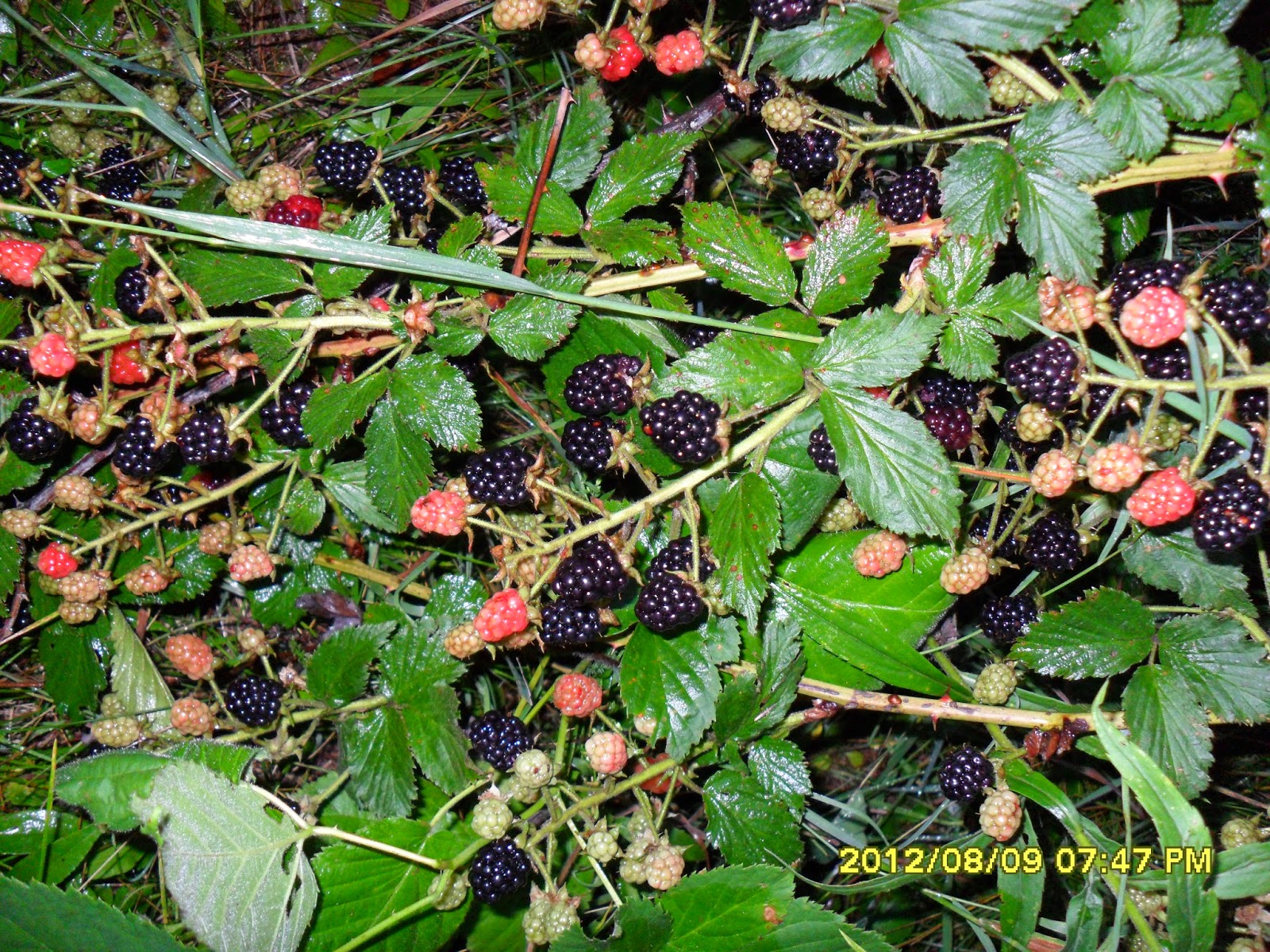
Blackberry pickin' time


Well, time to roll. Y'all take care now!!


Saturday, May 3, 2014

It continues....

What a week, weather wise! The gray, cool, cloudy, rainy weather brought back (bad) memories of last July. Hopefully it is not a harbinger of things to come. :) However, shortly after waking up early Wednesday morning, I heard a robin singing. 'Twas a cheery sound, especially when I peeked around the shade to see the gray, misty, foggy early morning; rather depressing to the spirits. Then, after walking to the other side of the house, I heard a White-Throated Sparrow, happily giving his song. Perhaps we humans are the only ones who let the weather get us down. The birds don't seem to mind in the least. :)

Last post I wrote about the raised bed/hugel beds in the seed starting greenhouse. Here's some more about that.


 Under the spread goat bedding is a hole about the length of the bed, with logs filling it. We then add some soil back in, along with lime, since the soil in that area seems to be acidic.

Better Homes and Gardens type fanciness, NOT! :)
Then keep adding soil and lime from time to time, until we get almost full, then add a layer of good dark compost, like this.

Pretty, ain't it?

The beds serve as a lower level spot to put seed flats; when the starts are in the garden, I'll transplant crops that I want to grow later into the fall/winter. Kind of an experiment, to see if I can keep my darlin' and the little munchers in homegrown toothsome delicacies late into the fall. Should work, think I. On to other things,

The rhubarb was coming up happily until......
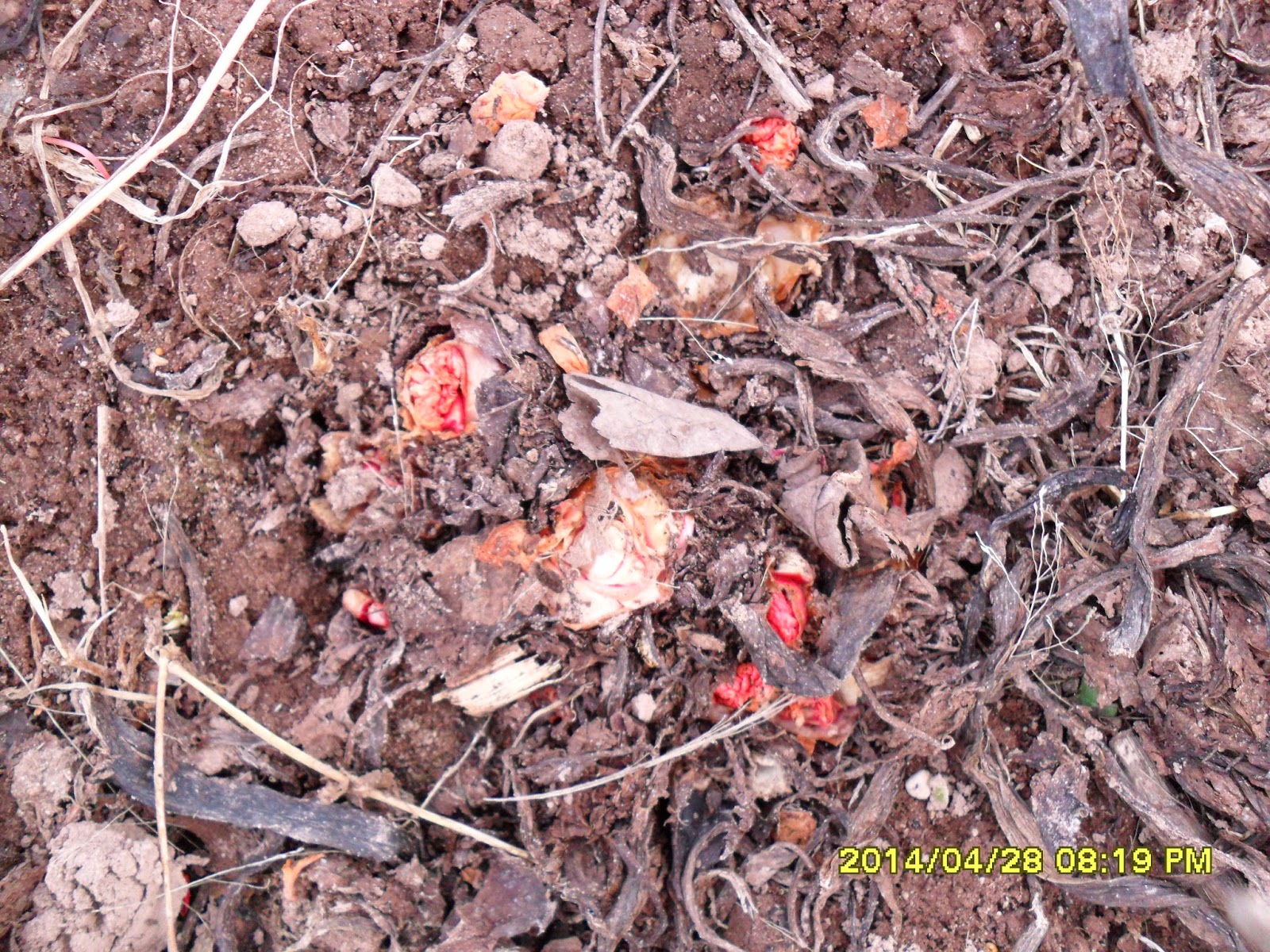
Yup, deer ate some of them down.
I don't remember having much of a problem with the deer chomping on my rhubarb, but this year, they came by one night and gobbled some of them up. I assume they are really hungry after the long winter we had. Time to extend the electric fence, I guess. I needed to do it anyway, this will light a fire under me to get it done. :)
Here's some more seedling pics.

Baby Cascade Glaze Collards, yum yum!
Teide, a red lettuce I'm trialing this year
Happy vibrantly-green tomatos
Lots of kale
Planning to start setting out transplants on Monday, both in the growing tunnel and under "low tunnels"- kale, green onions, lettuce, collards, chard in the low tunnels. Zucchini and cuke transplants under low tunnels inside the grow tunnel, the double buffering should protect them well from any (hopefully) light frosts we have from now until June. We'll probably set out the first tomatos under double cover in about a week or so. And of course, more seeds will be going into soil blocks as the spring rolls along. Busy, but fun, time of the year.
And here's some from the not-too-distant past, for old time's sake. :)

Simpson Elite lettuce, large-size and oh-so-good.


Lutz Green Leaf or Winterkeeper beets.
Ali Baba watermelon
Kuroda carrots, we love them.
And, my apologies for this last picture. 'Twas an awfully long, hard winter, as y'all know, but every time I look at this on my monitor background I marvel at the beauty of the cold, windswept landscape.
If my tracks weren't in it, it would be perfect, I think.


Next post I think I'm gonna talk a bit about soil blocks, maybe even post a little video clip of us making some. Gotta run, y'all take care now. Happy trails! :)

Saturday, April 19, 2014

First post for 2014

Happy spring! With the new growing season up and going (well, right now mainly in the seed-starting greenhouse), I needed to get writing again. With every new season, it seems I kinda take account of some things I'd like to do better "this year", such as keep up better on succession-plantings, get at the weeds earlier, do more seed-saving, etc. Well, one of the things I'm gonna take a stab at doing better this year is this blog. Maybe not a big article every time, but something, and some pics. There, saying I'm gonna do better makes me feel better. :)

After a very cold, snowy winter, I'm chewing at the bit to get growing again. As mentioned, the main action is in the seed-starting greenhouse right now. Such as this.....

Blue Scotch Kale
which will start landing on dinner plates hopefully early-mid June. Blue Scotch Kale is a different variety than I marketed last year; an open-pollinated variety, rather than the hybrid Winterbor, which is a good kale, but a variety which was not readily available when I was ordering, apparently due to a seed crop failure. Ah! The Achilles' heel of market gardening, going back to the seed companies every year, expecting them to have everything you need. That's one of the reasons I want to grow out more seed this year. Also, this lettuce,


though of diminutive size now, should be ready for a good salad early June, maybe even late May. I'm trying some new lettuce varieties this year. My workhorse remains Nevada lettuce, but I'm gonna give Muir and Teide (from Johnny's Seeds) and Kweik (from Wild Garden Seeds) a whirl this season. Hopefully Teide will be a good red replacement for Magenta, which I was not really happy with last season. And, these zucchini

Partenon Zucchini

are, I hope, gonna start producing early June. If the weather cooperates. And I get them settled into the tunnel in time, and care for them as well as I hope to. And we get enough sun. That's what I'm hoping for, anyhow.

We got a kind of hybrid hugel/raised bed in the seed starting greenhouse finished today. Planning to make 5 more. The method behind my madness is to use the sides of the raised bed (logs) as the lower tier for my seedling flats to rest on. Then, when the seedlings go out into the open gardens, hopefully late May, I can transplant in a few tomatos and other warm loving crops into the beds, and let them grow all summer. Hopefully can have a few fresh maters, cukes, and zukes quite late into the fall, to keep my better half happy in the kitchen. Round about mid-September, I can clear out some of the lower foliage, transplant in some late started lettuce, spinach, and other greens, and when the warm-weather crops stall out, cut them off at the ground, and let the cool-weather loving greens keep on growing, keeping them from freezing too badly with the use of this beast

The Barrel Stove

which has been keeping the new seedlings mostly happy since the beginning of April. It burns a stored solid form of solar energy, which we have in abundance in the woodlot. :)

And I would be remiss if I didn't share a shot if this with y'all.

Kiddo seed-starting
One of the best aspects of growing is seeing the kids latching onto the concept. They love to help out in the greenhouse, making soil blocks, putting seeds in, etc. And, they like starting their own seeds, sometimes in soil blocks they made, more often in cut-off milk jugs and little patted out mud-pies with seeds in them. And the excitement when the seeds make an appearance! Makes the modern Ipads/pods, cell phones, and other (often idiotic) gadgets pale in comparison. :)

Well, I better get scooting along, throw some more wood in the greenhouse stove, and wind things down for the evening. Before ending, here's a quick snap of the first flowers of spring

Snow crocuses
in the lovely and gracious Janice's flower garden area alongside the house. They are a bit unhappy, with the gray weather and having had inches of wet snow dumped on them after coming up, but should be feeling better when the sun comes again. :)

In closing, here's a couple "good thoughts", sent to me by an esteemed co-worker/friend. After reading them in my inbox, I hastily dubbed her Madam Doctor of Philosophy. :)

In life, there are 4 things you can’t get back…


The stone
after the throw...

The word
after it's said...

The action
after it's done...

And, the time
after it has passed...


 And, this one.

A teacher walks into a classroom and sets a glass jar on the table. He silently places 2-inch rocks in the jar until no more can fit. He asks the class if the jar is full and they agree it is. He says, “Really,” and pulls out a pile of small pebbles, adding them to the jar, shaking it slightly until they fill the spaces between the rocks. He asks again, “Is the jar full?” They agree. So next, he adds a scoop of sand to the jar, filling the space between the pebbles and asks the question again. This time, the class is divided, some feeling that the jar is obviously full, but others are wary of another trick. So he grabs a pitcher of water and fills the jar to the brim, saying, “If this jar is your life, what does this experiment show you?” A bold student replies, “No matter how busy you think you are, you can always take on more.” “That is one view,” he replies. Then he looks out at the class making eye contact with everyone, “The rocks represent the BIG things in your life – what you will value at the end of your life – your family, your partner, your health, fulfilling your hopes and dreams. The pebbles are the other things in your life that give it meaning, like your job, your house, your hobbies, your friendships. The sand and water represent the ‘small stuff’ that fills our time, like watching TV or running errands.” Looking out at the class again, he asks, “Can you see what would happen if I started with the sand or the pebbles?”

<Thanks again for sharing the above thoughts, R. You made my day. :)>

That's it for today, y'all take care now. :)


Thursday, August 29, 2013

Of planting lettuce in the rain, vermicomposting, and hugelkultur beds

Been a little while since I last posted. I would like to keep up with this blog a little more regularly, but my inclination seems more toward actually growing things, rather then writing about growing those things. However, as I sit here writing, the rain is gently pattering on the roof- so what a good time to update. Ah, this rain is a blessed relief after the beastly hot day. It will also be good for the about 200 new baby lettuces and some Red Beard bunching onions we set out as it started drizzling. The thunder was booming sporadically overhead for a little while, and a little lightning as we were setting them out, but we got them planted and headed into the house. Kinda loony, I know, being outside in those conditions, but, as my dad has said before, if you're not living on the edge you're taking up too much space. <Laughing>

I'd like to share some pictures-

What a robin sees looking east out of one of the pie apple trees.


Looking west from the roof of my rattly old farm truck.


Young "Nevada" lettuce in the garden area known as "C-plot".


The next one is kinda funny. One of my brothers and his wife and kids recently went out east. While there, he stopped in at Eliot Coleman's Four Season Farm. Eliot has been probably the biggest influence in my market gardening vocation. I have four of his books, and have been greatly inspired by his model of farming.  Anyhow, my brother stopped there, walked through the greenhouses and fields, and got some produce at the farmstand. One of the things he purchased there was one of the beautiful beefsteak tomatos. He made sure to save one to bring home to us.

 
Yes, indeedy, it was as tasty as it was beautiful. :)
And a couple more pictures.......


Beautiful Red Russian Kale, growing in <our> garden.


Cherry tomatos......


not tied up as nicely as I would like, but as I once heard another gardener say, "Done is better than perfect."
Now, on to vermi-composting. For those not familiar with the term, it is essentially using earthworms (usually red wrigglers) to digest organic matter, turning it into what is called worm castings. I originally wanted to make some worm beds and raise worms, to supplement chicken feed for our laying hens. We got one made, put in some compost and worms, and have been adding goat manure and spent lettuce and kitchen scraps. The system isn't running perfectly yet,and we are still learning what it takes to keep the little critters happy, but we have been able to harvest some worm castings. Looks a little like this, worm poo mixed with some not totally digested organic matter.


Thanks, son Joshua, for displaying a handful of worm poo and compost. :)


The above is plant food par excellence, I believe better than anything to be found in a plastic bag on the feed store shelf. If I had a semi-load of it, I'd be in my glory. As it is, until we get lots more worm beds going, we have to use it more sparingly, lightly applying it to the garden beds and mixing with water for soil drenching. Worms are one of the gardener's best friends, loosening the soil, helping in the cycle of breaking down organic matter, and leaving behind their nutrient-rich droppings. I'm so glad God made 'em. :)

Another thing I've been learning more about lately is permaculture. I've heard about it before, but never really gave it much thought. Then a friend from South Carolina dropped in for a visit this spring, and as we were chatting in the warm sunny greenhouse, he mentioned the building of what are known as "hugelbeds". Basically, trenches are dug, logs are laid in (better yet if they have already started to decompose), then some nitrogen-rich matter is added on top of the logs (I'd use things like green grass, goat manure, maybe a little bloodmeal or alfalfa meal or comfrey leaves); then the whole heap is covered with earth. It seems some of the benefits of these hugelbeds are earlier warming in spring and staying warmer later in the fall (from the decaying action of the logs), good drainage, and the logs soak up water like a sponge in the wetter seasons, and make it available to the plants when they need it. The decomposing logs break down for years, thereby feeding the soil and plants. I also have (perhaps irrational) ideas like planting tomatos along the inner facing sides of two parallel mounded beds, then when cool fall weather starts, putting little hoops over the valley between the two beds, cover with plastic, and basically create a mini-climate with the two mounds as the "walls" and the little hoops along the top as the "roof" of a growing tunnel. Kinda hard to explain, but it might work. I'd love to get a "real greenhouse" someday, but try not to take on debt, so I use sometimes unorthodox methods to make do until we can get one. :)

I hope to make a couple of these hugelbeds this fall, and plant a little of each crop we grow in them next spring, just to give it a whirl. I am reluctant to change over totally to something I am not familiar with, replacing what I know works all at once, but if there is something to this hugelkultur, I'll start changing over more and more to it. Obviously, making a bunch of buried log piles in my field will be a somewhat permanent thing, with the logs decomposing for years. Here's a link to a short video for those who are interested, about Sepp Holzer, who is one of the pioneers of the permaculture movement.

http://www.youtube.com/watch?v=Bw7mQZHfFVE

There is a lot more out there if you would like to dig into it. I'm pretty excited about it. Well, I'm gonna run along now, leaving you with a beautiful sunrise photo over Keweenaw Bay, taken last fall.


The gracious sun with light now brightens....


Wednesday, August 7, 2013

What month is it, garden help, and a recipe

The other day, as I was working in the seed starting greenhouse, the irony of this growing season became apparent. The calendar tells me it's early August, the weather seems June-like (some days more like November), crops coming off seem more like mid-July, my energy level feels like November, but the seed-starting greenhouse looks like mid-April!

Lots of fall crops in my funky-looking but functional seed starting tunnel. (April-like)

A cozy Sunday afternoon in the UP, July 28th. (November-like)

No matter what month it really is, there's lots of food being harvested. Lettuce, carrots, cucumbers, zucchini, summer squash, arugula, braising mix, scallions, kale, swiss chard, endive, escarole, and green peppers have been filling up our market tables. The tomatoes are still waiting for summer, not realizing they better get a move on. :)


Simpson Elite, a beautiful ruffly lettuce, growing happily in the cool weather.


Lakota Squash

The above winter squash is one of some different winter squash we are trialing this year. Beautiful looking, I'm hoping they are as tasty as they are pretty. If they pass the trial, I may grow some out for market next year.

The other day, while hoeing a late squash/zucchini bed, I heard a voice behind me, "Dad, can I do that?" Looked around, and my son John was coming along. I asked him if he wanted to, he said yep, so I turned him loose with the hoe. I had to get the camera going. 


John, affectionately nick-named Pooh, helping wear out a collinear hoe.

Now here's a good recipe from one of the faithful Hancock Tori shoppers, Susan Burack.


Vegetable Casserole
(Susan Burack)
 

2 # approx Swiss Chard, or collards, spinach, combo of greens
------
2 T butter
2 T olive oil
3 onions, chopped
3 or more cloves garlic chopped
6 small zucchini, sliced or diced
1 c basil, chopped
1/2 c parsley, chopped
Salt and pepper
-----
6-8 eggs, beaten
3/4 c Swiss (or other) cheese, grated
3/4 c Parmesan (or other) cheese, grated

Steam greens in an inch of salted water until wilted, drain and chop.

Heat butter & olive oil. Cook onions until wilted. Add garlic, zucchini,basil, parsley, salt, and pepper and cook until barely tender, stirring.

Combine greens, vegetable mixture, cheese and egg mixture

Bake in greased pan for 25 - 30 min at 375 degrees F

Tian is the French for casserole and there are many variations. Be creative!


 To end this post, here's some pictures I ran across while getting the recent ones off my camera for this post.


Twilight view from the canoe in Otter Lake, last fall.

Another shot of Otter Lake, last fall as well.

Another serene scene, don't remember exactly where I took this one.

And my apologies for this last one to those who love the "swatting season" here in the UP, but not the "shoveling season". I'm not quite ready for the following scene either, but it is beautiful none-the-less. :)


Snow on the trees bordering our walking trail, photo by Janice.

Time to go..............ya'll take care now!!